

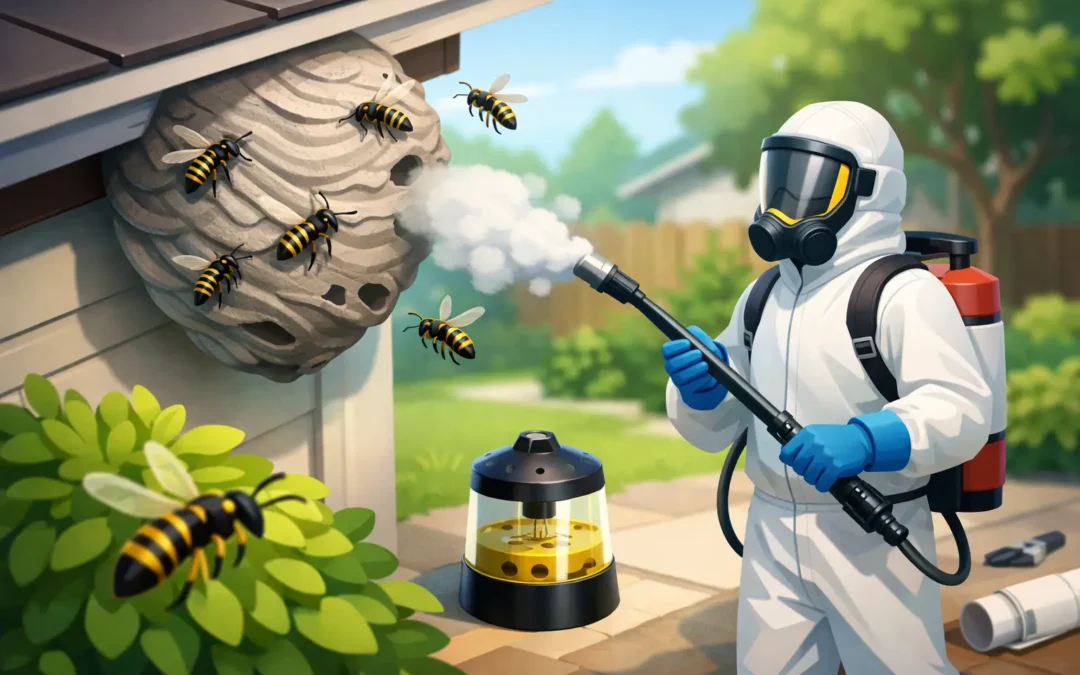
A single wasp circling the patio is annoying. A steady stream of wasps disappearing behind siding, under a deck, or into the ground is a problem that needs a careful response. Knowing how to handle wasp nests starts with one rule: do not get close enough to make the colony defend itself. Wasps can sting repeatedly, and a disturbed nest can turn a manageable nuisance into an urgent safety risk in seconds.
The right response depends on the nest’s location, size, species, and who uses the area. A small, open nest on a detached shed is very different from yellowjackets nesting in the lawn near children, pets, customers, or employees.
Start by Identifying the Risk
Do not rely on the nest alone to identify the insect. Paper wasps, yellowjackets, hornets, and some bees can all appear around homes and businesses, but their behavior and nesting sites differ. If you are unsure what you are seeing, keep your distance and observe the insects from indoors or several yards away.
Paper wasps often build open, umbrella-shaped paper nests beneath eaves, porch ceilings, railings, and outdoor fixtures. They can be defensive when someone gets too close, but they are usually easier to spot because the nest is exposed.
Yellowjackets are often the bigger concern. They may nest in wall voids, attics, under decks, inside landscaping features, or underground. A ground nest can look like a small hole with frequent insect traffic. Never mow, dig, spray, or block the opening. Vibrations and sudden activity can trigger a strong defensive response.
Hornets generally build larger enclosed paper nests in trees, rooflines, sheds, or other sheltered areas. Their size and the number of insects around the nest make professional removal the safer choice.
Treat any nest as high risk if it is close to a doorway, walkway, playground, outdoor dining area, garage, pool, or work entrance. It is also high risk when a household member has a known sting allergy, when the nest is inside a wall or roof structure, or when you cannot see exactly where the wasps are entering.
What to Do Before Wasp Nest Removal
Your first job is to reduce the chance of an encounter. Keep children, pets, visitors, and staff away from the area. If the nest is near a commonly used entrance, use another door until it is addressed. Marking off the space is often enough to prevent someone from accidentally getting too close.
Avoid swatting at wasps, hitting the nest, spraying it with a hose, or throwing objects at it. These actions do not solve the colony and can cause wasps to swarm. Do not seal a wall opening while wasps are still active inside. They may find another route into the building, including living spaces.
It also helps to remove what is attracting wasps to the immediate area. Keep garbage cans closed, clean up spilled drinks and food outdoors, cover recycling, and pick up fallen fruit. This will not eliminate an established nest, but it can reduce foraging activity around patios, loading areas, and trash storage.
If someone is stung, move calmly away from the nest area. Wash the site with soap and water, use a cold pack for swelling, and monitor for signs of a severe allergic reaction. Trouble breathing, swelling of the face or throat, dizziness, widespread hives, or fainting requires emergency medical help immediately.
How to Handle Wasp Nests Safely at Home
A very small, exposed nest may sometimes be handled by a homeowner, but only when it is far from people, the colony is limited, and there is a clear exit route. Even then, the risk is not zero. If you are uneasy, have mobility limitations, lack protective clothing, or cannot confirm the nest type, do not attempt removal yourself.
For a small exposed nest, use a pest control product specifically labeled for wasps and hornets, and follow the label exactly. Wear long sleeves, long pants, closed-toe shoes, gloves, and eye protection. Keep other people and animals indoors. Plan your route away from the area before you begin.
Treatment is generally less risky when wasps are less active, such as early morning or late evening, but low activity does not mean the nest is empty. Apply the product from the distance stated on the label, then leave the area immediately. Do not stand nearby to watch the result.
Wait until there is no visible activity before removing an exposed nest. Place it in a sealed bag and dispose of it according to local waste rules. Check the site over the next several days. If wasps continue returning, the nest may be larger than expected or connected to a hidden entry point.
Do not use gasoline, fire, boiling water, homemade chemical mixtures, or any method that creates a fire, poisoning, or property-damage hazard. These approaches are dangerous, ineffective in many situations, and especially risky around structures.
When You Should Call a Professional
Professional wasp control is the right choice more often than homeowners realize. Hidden nests are difficult because the technician must locate the colony, treat it effectively, and prevent wasps from moving deeper into the structure. A visible opening does not reveal the full size of a wall-void or attic nest.
Call for help if the nest is large, active, underground, inside a wall, high on a roofline, or located near people. You should also call if you have already used a store-bought spray and wasps are still active. Repeated spraying can make the colony more defensive without reaching the source.
Businesses should act quickly when wasps are near customers, outdoor seating, dumpsters, delivery doors, warehouses, schools, or rental properties. One sting incident can disrupt operations and create a serious safety concern. Property managers should document the location, restrict access, and arrange removal rather than asking tenants or maintenance staff to take unnecessary risks.
A licensed pest control technician can identify likely nesting areas, use the appropriate treatment method, and advise when it is safe to reopen the area. At Super Pest Control, trained technicians provide practical wasp and hornet treatment for urgent residential and commercial situations, with responsive service when a nest cannot wait.
Prevent New Wasp Nests From Forming
After removal, prevention matters. Wasps are drawn to protected gaps and quiet areas where a colony can grow unnoticed. Inspect eaves, soffits, vents, deck undersides, sheds, fences, attic screens, and exterior utility openings during spring and early summer. Small starter nests are far easier and safer to address than a mature colony later in the season.
Seal cracks and gaps only after you are certain no wasps are still using them. Repair damaged screens, cover vents with suitable screening, and keep exterior trash areas clean. If wasps repeatedly appear around the same roofline, deck, or wall, there may be a structural opening that needs attention.
Do not assume an old nest guarantees wasps will not return. Many species do not reuse the exact nest, but they may build nearby if the site remains sheltered and accessible. Regular exterior checks are the best way to catch early activity before it becomes an emergency.
A wasp nest is not a test of bravery or a job to rush through. Give the colony space, protect everyone around it, and get expert help whenever the nest is hidden, active, or close to daily life. Fast action is useful, but safe action is what keeps one nest from becoming a painful and expensive problem.