

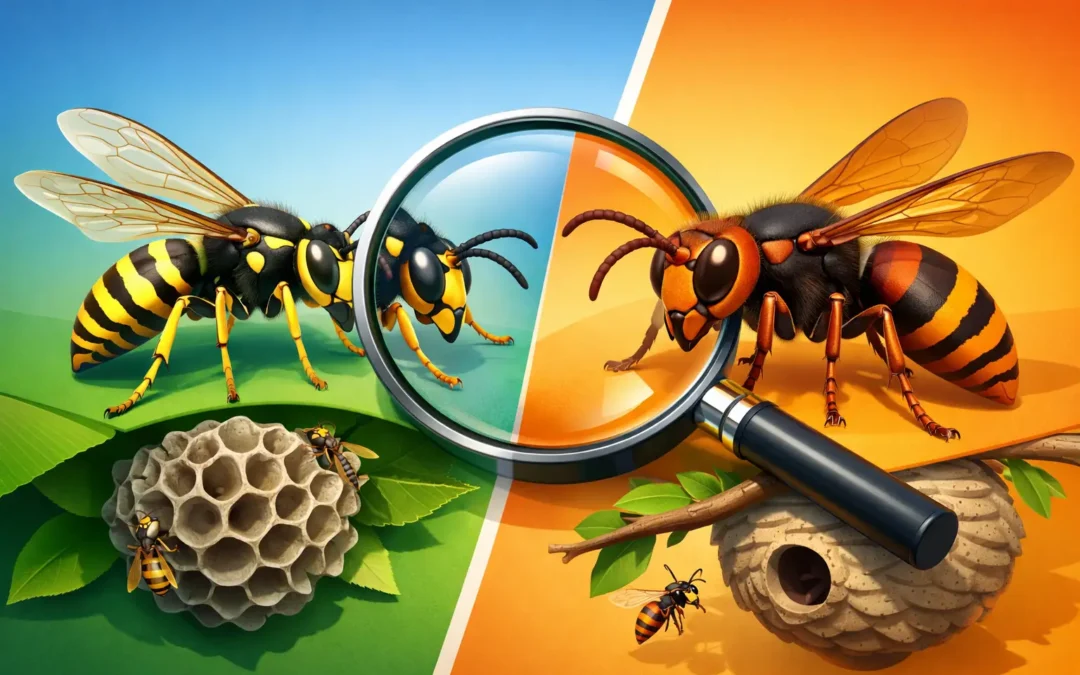
A large yellow-and-black insect circling your deck can make anyone nervous, especially when several are flying in and out of a wall, shed, or roofline. Accurate wasps vs hornets identification helps you judge the risk, avoid disturbing an active nest, and decide when professional removal is the safer choice.
The practical answer is that hornets are a type of wasp, but they are usually larger, heavier-bodied, and more likely to build enclosed paper nests. Common wasps, including yellowjackets and paper wasps, can look similar at a distance. Nest location and insect behavior often tell you more than color alone.
Wasps vs Hornets Identification: What to Look For
Start from a safe distance. Do not stand beneath a nest, block its entrance, or swat at flying insects to get a closer look. A phone photo taken from several yards away may be enough to help a pest professional identify the species.
Size and body shape
Hornets are typically the largest social wasps you will see around a home. In the United States, the European hornet is commonly about 1 to 1.5 inches long. It has a broad head, a thick waist compared with many other wasps, and a sturdy, reddish-brown body marked with yellow bands.
Most yellowjackets are smaller, often around one-half inch long. They have a compact, smooth-looking body with sharp black-and-yellow markings. Their narrow waist is visible, but their overall shape is less long and dangling than a paper wasp.
Paper wasps are usually slim and leggy, with long legs that noticeably hang down when they fly. They may be brown, reddish, or yellow-and-black depending on the species. People often mistake them for hornets because they build visible paper nests, but paper wasps are generally much smaller and more slender.
One caution: size is hard to judge when an insect is moving quickly. A large yellowjacket can appear hornet-sized when it flies close to your face. Use body shape and nest style to support your identification.
Color is helpful, but not decisive
European hornets are usually reddish-brown with yellow sections on the abdomen. Their faces may look pale or yellow. Yellowjackets tend to show a brighter, cleaner yellow-and-black pattern with little reddish coloring.
The bald-faced hornet, despite its name, is also a type of yellowjacket. It is mostly black with distinct ivory-white markings on its face and body. If you see a large black insect with white markings entering a gray, football-shaped paper nest, you are likely dealing with bald-faced hornets.
Color alone can be misleading because lighting, distance, and individual variation change what you see. Never assume an insect is harmless simply because it is not bright yellow.
The Nest Usually Gives the Best Clue
Finding the nest changes the situation. Even species that seem calm while searching for food can become defensive when you get near their colony.
Hornets commonly build large, enclosed nests made from a gray, paper-like material. Bald-faced hornet nests are often attached to tree branches, shrubs, utility structures, soffits, or the side of a building. A mature nest can grow larger than a basketball and may contain hundreds of workers.
European hornets often choose protected cavities. You may find them inside hollow trees, wall voids, attics, chimneys, sheds, or gaps around exterior structures. Their nests are usually hidden, so the main clue is repeated insect traffic into one opening.
Yellowjackets frequently nest underground. Watch for a steady stream of insects entering and leaving a hole in a lawn, garden bed, retaining wall, or crack near a foundation. They can also nest inside walls, ceilings, and other enclosed spaces. This is one reason lawn mowing, trimming, and landscaping can trigger painful surprise encounters.
Paper wasps build open, umbrella-shaped combs. You can see the exposed cells beneath the nest because there is no outer paper shell. These nests often appear under porch ceilings, deck rails, eaves, shutters, outdoor furniture, and light fixtures. A small, visible paper wasp nest may look manageable, but disturbing it at close range can still lead to multiple stings.
Behavior Around Your Home Matters
Hornets and yellowjackets are social insects that defend their nest when they believe it is threatened. They can sting more than once, unlike honey bees, and their stings can be painful. The risk rises quickly near a nest entrance, particularly in late summer and early fall when colonies are at their largest.
Yellowjackets are often the more persistent nuisance around outdoor meals, garbage bins, sweet drinks, and meat. They may repeatedly land on food or crawl into soda cans. European hornets are more active after dark than many other stinging insects and can be drawn to porch lights. Paper wasps often patrol around their nest site or search for caterpillars and other insects to feed their young.
Do not use behavior as a reason to test them. Knocking on a wall, spraying water into a nest, or trying to cover an entrance can cause workers to pour out at once. If you see frequent traffic at one spot, treat it as an active nest until a trained technician says otherwise.
Wasp, Hornet, or Bee? Avoid a Costly Mistake
Bees are often fuzzier and rounder than wasps or hornets. Honey bees have visibly hairy bodies and tend to look golden-brown rather than shiny yellow and black. They also collect pollen on their legs. Wasps and hornets have smoother bodies, narrower waists, and longer-looking legs.
That distinction matters because bees play an important role in pollination and may be removed differently. A pest control professional can assess the insect and the nest location before recommending treatment. Do not rely on a single online photo comparison when a colony is inside a wall or close to children, pets, customers, or employees.
When a Wasp or Hornet Nest Needs Professional Removal
A nest high in a remote tree may not require immediate removal if it is well away from doors, play areas, walkways, and work zones. In many regions, social wasp colonies naturally die out after cold weather, although a nest inside a structure can create ongoing concerns and should be assessed.
Removal is the right call when a nest is near an entry door, deck, playground, driveway, garbage area, outdoor dining space, or a high-traffic commercial entrance. It is also urgent when insects are entering a wall, ceiling, attic, or vent. Blocking the opening without treating the colony can drive stinging insects farther into the building, where they may emerge indoors.
Call for professional help promptly if anyone in the home or workplace has a known sting allergy. Seek emergency medical care immediately for trouble breathing, swelling of the throat or face, dizziness, widespread hives, vomiting, or fainting after a sting. These can be signs of a severe allergic reaction.
What Not to Do With an Active Nest
DIY sprays can be risky and often fail when the nest is concealed. Spraying from too close exposes you to stings, while surface spraying may not reach the colony or the queen. Burning a nest, using gasoline, flooding an underground nest, or sealing a wall opening are especially unsafe choices that can create fire, contamination, property damage, or an aggressive swarm.
For a safer response, keep people and pets away from the area, close nearby windows, and avoid using loud equipment near the nest. If the nest is near a public-facing business area, mark off the space until it can be inspected. Professional treatment focuses on the species, nest location, colony size, and the safest method for the property.
Get a Clear Answer Before the Problem Grows
You do not need to identify every stripe perfectly to make a smart decision. A large enclosed paper nest, insects entering a wall, or repeated activity near the places people use most are enough reason to act carefully. Take a photo from a safe distance, avoid disturbing the colony, and have a licensed pest control technician confirm what you are dealing with before a small problem turns into a sting emergency.